|
|
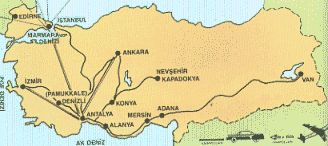
History and geographical geographical location Alanya is on the degree of latitude 36 ° 33 min. of Greenwich and on the degree of longitude 32,01. Alanya is in the district Antalya at the Mediterranean and east in the gulf of the same name. Of Alanya the Mediterranean, east the district Gazipasa, is southern west the district Manavgat and north is the high mountain chain with plateaus. The mountain massif in the north Alanyas is the coastal mountain chain of the west Taurus mountains. is here the mountains and summits between 500-600 and 2500-3000 m. highly.
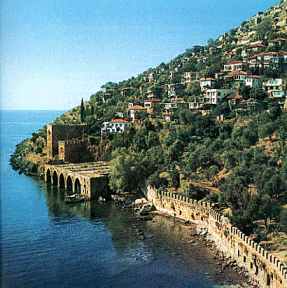
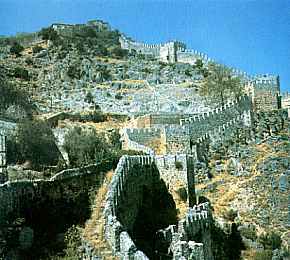
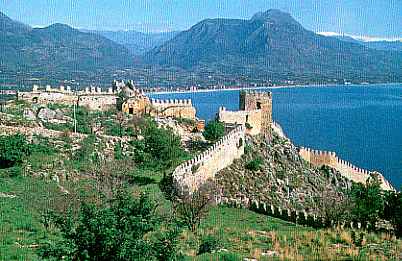
The low area form at the sea along spreading valleys. The descent from the high mountain summits to the valleys one encounters frequently on plateaus, which run out in the west Alanyas north the peninsula. Here the valleys are cliffed and fall in relatively steep cliffs off In the south is situated the peninsula of Alanya, surrounded with 6500 m. fortress wall. The peninsula is separate by valleys from the Taurus mountain. In the south the sea represents a memorandum, in the north blocks the Taurus mountains Middleanatolien, Kusyavasi, Kocadavut Gedigi and additionally the Dim valley. From the waterfalls of the same name rock beds resulted, by which a passage was formed.
History of Alanya The settlement of Alanya goes back on unknown epochs to that History. Of it the 1957 find of people skeletons, made by Professor Dr. Kilic Koekten, and fossils in the Kadrini cave in the northeast of the city, between the villages Bademagaci and Oba witness. The so historical-rich Alanya belonged its position accordingly partly to Kilikien, partly to Pamphylien. The father of history wrote the following over this area: " as itself fleeing after the Trojan war here to settle (1,820 v. Chr.), they wanted by the people from different races were taken up " Thus it understands itself that the Hethiter into this area penetrated, in the first half 14. Jh. v. Chr. 6,000 humans killed and Klikien as well as Pamphylien included into their realm. Pamphylien means " very rassic, very categorically ". Those most, which came into this area, took it because of the fruitful soil, its dense forests, that coast and the steep mountain walls of the Taurus mountains which can be achieved with difficulty and remained in this ideal region.
In the years 224 - 188 v. Chr., when Antiochus the large one filled Kilikien completely, Korakesion (Alanya) remained spared, because a siege and an income of the city seemed connected to large difficulties also. Into Korakesion one went so far that one revolted oneself against the Syrian king. One went on the sea and began, which at that time was simple to earn living costs as Pirates. Korakesion escaped not only occupation, but could also by the Greek culture be influenced. The glass lamps and tear glasses, in Syedra, prove those in that Were found to environment of the Cokca church. Under the Pirate Tryphon became Korakesion a feared place that Environment. The same Pirate went so far the fact that he to Ehmedek, which sanctuary of the Arabs penetrated there, and let a solid wall of stone establish. This Pirate used the today's Kizlar Yarigi or the natural caves called as Pirate caves depot of its booty courses. According to rumors it is to have blocked the area between the Damlatas cave and the city hall and to have re-designed the Alanya fortress (Korakesion) into an island. At the same time the warriors of the powerful Roman realm dared themselves into the coastal towns forwards, let realms the ransom for kidnapped girls of personalities pay and took head expensive. Therefore nobody drove on the more outside, and that had the consequence that the Roman administered cities Food scarceness had. Around " the people from this problem to to release ", Antiochus began 139 v. Chr. a war, in which he struck the strong Pirate destroying. But the Pirates organized themself new and left the Mediterranean area rumble. In order to make for them from, Antonius was assigned by the Roman empire to suffocate the pirateness in the germ. Although Antonius 103 had expanded v.Chr. its empire the far beyond boundaries, the Pirates tried again and again to win their old power back.
Thus they broke in in many cities and suburbs of the coast and went even so far that them the daughter of the emperor, that with their extermination was assigned, kidnapped, which shifted the Romans in " rage ". The Roman Empire believed to have to prepare for the raids and demands for ransom for kidnapping an end and assigned the very much enabled general Pompeus its army. This commander understood it, with his attacks on the country and from the sea the Pirates, which had shifted for many years the Mediterranean coast in frights, into the knees too force and they to exterminate. The Romans, who had finally gotten this problem into the grasp, gave the area Kilikien after Caesars of death to the ruler Antonius. In this time made so famous the Egyptian queen Kleopatra on its Mediterranean round travel the acquaintance with Antonius, become because of their beauty. They fell in love into one another and married. As wedding gift got Kleopatra of Antonius Korakesion (Alanya). Kleopatra let to fell Zedern forests which are to the sea and create to Egypt for the building of their fleet. Oktavius from Rome, which was Antonius and Kleopatra a cathedral in the eye, explained the war to them. The pair held itself at this time in Greece up. For a large-scale attack with Alexander D large ones looked the refuge up fallen in love. Antonius noticed as the first that they were fallen into a trap and committed suicide. It Kleopatra followed into death, by being able to be poisoned by a queue bite into the chest. The buildings destroyed by Pompeius in the fight against the Pirates were again structured by the Romans in best way. The best examples of it are the interior castle of the fortress in Alanya, the churches on the promontory Cilvarda as well as the Asarlik churches in Mahmutlar Kasabasi in the proximity of the village Kargicak.
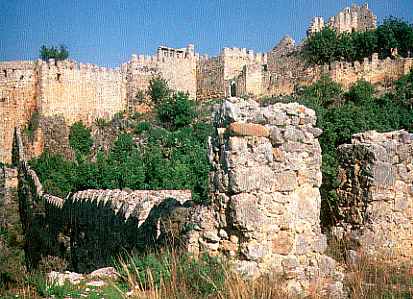
Again the Korakesion (Alanya), structured of the Romans, kept its meaning to in 7. Jh., when it was stormed of the Arabs, which increased its meaning only. In the Byzanz epoch it received Kolonoros, which " beautiful mountain " meant to the names. The old name Korakesium means " sky crow ", and one called the inhabitants " sky crows " This gave it in the old Alanya to very much. These birds lighting up in many colours are be become very rare and can in Camyolu and Mahmutlar be only seen. Islamic epoch in Kolonoros (Alanya) At the beginning of the Islamic epoch a Roman city was taken after the other one, but remained independent for Kolonoros (Alanya) owing to its good attachment. Some historians maintain that the Arabs here came, and mean, the Sitti Zeynep Tuerbe is a proof for it. Other historians maintain that its Excellency Hueseyin no enkelkind named Zeynep had, and states that this burial place was built for an invented name by the osmanischen prince sex Bektas, got and actually for its Excellency Ali was intended It is certain however that the Arabs shifted the Byzantiner at this coast in unrest, which facilitated the Seldschuken conquest. After the income of Antalya by the Seldschuken these wanted to finally have the upper hand at the Mediterranean, which was not possible without the area around Alanya. They did not shrink from a trouble to storm this almost uneinnehmbare fortress. Those Governor von Antalya, Ertokus Bey, informed the Sultan Alaueddin Keykubat, about the necessity for occupation and got from him the job, all preparations to meet. The army penetrated toward Kolonoros and relocated the fortress. Under the command of the Sultans plans for storming were made. First the commander of the fortress, Kir Fart, was requested, to arise without blood pouring. Kir Fart opposed this request and defended two months long the castle. The unsuccessful attacks and the encirclement made the Sultan ever more hopeless. One evening raised he his hands to the prayer and asked God for assistance. At this night in the dream a good-natured shape, which spoke the following words, appeared to it: " this fortress is very difficult to take, but God becomes you the page. So a fortress to storm will succeed only to you." The lucky awaked Sultan and called up its war council. All laid this dream out as a character of the victory. On the instruction of the Sultans 100 oxen, 1000 sheep and 10,000 dirhem of coins under the people and levers were distributed. After the last preparations the army with " Allah, Allah" calls stormed the castle. Kir Fart had not been up to to this large attack. It saw that it had to surrender with its warriors.
The governor von Antalya, Muebariziddin Ertokus, erbot itself for reasons of the neighbourhood as an intermediary and align the Sultan out, that Kir Fart ready be, itself arise, if one promise, it no hair curve. The Sultan gave its warranty with largest satisfaction. Kir Fart was just as relieved and opened personally the burgtor in its whole width, in order to receive the Sultan. This assured a suburb to it toward Konya, where he was allowed to remain time of its life. He married the daughter of the Sultans, princess Hand'i (Mahperi Sultan). A rumor to follow is Sultan Alaueddin Keykubat, after he had besieged 4 months long unsuccessfully the fortress, all goats of the environment together to have driven and these at the night with burning torches/flares at its horns under that War cry " Allah, Allah " against the gate of the fortress drove. Kir Fart is to have given the instruction in view of this enormous attack to open the gate. After this victory Sultan Alaueddin Keykubat Kolonoros gave its name Alaiye. On the triumphant advance back after Antalya the Sultan gave the instruction, 35 km von Alanya removes been situated fortress Alara to the Seldschukenreich to include. A scout reported to the commander of fortress and Brother of Kir Fart of the defeat of its older brother, on which this fell and died in faint. Nothing different one remained for its attendants, than arising in view of the supremacy. Eleven years later on instruction of the Sultans at the foot of this fortress a large Karawanserei was established (Alarahan). With the victory of Sultan Alaueddin Keykubat over Alanya began the gloss-fullest epoch of the Seldschuken. Alanya and its environment were decorated by building masters on the art-fullest. Despite the centuries passed in the meantime these buildings did not lose at beauty and to count to the only one of the world. Through many years Alaiye remained in the possession of the Seldschuken, until its power faded and the city came under the rule of the Karamanoglu, another Turk trunk. On the way after Oba Guelevsen are today still buildings of the Seldschuken and the Karamanoglu trunk in their artful building method keep remained. Alaiye (Alanya) is taken by the Osmanen Conquest by the Osmanen took place under Sultan Fatih Mehmet. At this time was this beautiful city under the rule of Kilic Aslan, a son of the Seldschuken-Lord of the Karamanoglu, Luetfue Bey. Sultan Fatih assigned the commander Rum Mehmet with occupation. Due to the relationship of rum Mehmet and Kilic Aslan lead the too nothing. Therefore general Gedik Pascha from the Jenitscharen assigned. 1471 succeed it to it without much circumstances to incorporate by an agreement with Kilic Aslan Bey Alanya the osmanischen realm. Kilic Aslan is awarded Guemuelcin in Thrakien, of where out its children, one hunts pretending, to Egypt flees and dies a little later. Even in bad times Osmani Rich could set no enemy a foot into the beautiful city. Many unforgettable personalities grew up, and around the Osmani realm there made themselves earned. Under Sultan Murat I. the Janitscharen Militaerorganisation one introduced. In the Hacova war 1596 they could achieve a victory after the other one for the government and provided for the furthest propagation of the boundaries.
After the Hacova war the Janitscharen came into disfavor and became, to Sultan Selim III. on the throne came oneself, to a rising problem. This Sultan made preparations, in order to resolve the Janitscharen. While itself Nizam iCedid endeavored to organize the army again Abdurrahman Pascha, a son of the Kadis Mehmet Efendi, was which was again a grandchild of the famous son of Alanya Seyhuelislam Minkarizade, Kadi in Kayseri. Its uncle, Ali Efendi, was at the same time a civil servant in Konya Bozkir. It was killed with a rebellion of the people, its fortune was divided and its landbesitz was seized. As Abdurrahman Pascha this message received, quit it its posts, got themselves from Babiali permission and went after Seydisehir, in order to take revenge. With the Ferman of the Sultans it marched against Bozkir, destroyed the murderers of its uncle and got the government under check. Padischah let it to itself call, in order to express it its gratitude for it. The success of Abdurrahman was at the same time a success, the again organized troops of Nizam i Cedit. Finally the Janitscharen killed Sultan Selim III., on which Alemdar Mustafa Pascha assigned the successful Abdurrahman Pascha to hurry the new Padischah to the assistance. |