| The
time ball, one of the salient buildings of the earlier
port picture, was an important mechanism. Time balls for
shipping developed first in England. 1873 decided the
realm to set on important German harbours identical
mechanisms. 1875 sketched the director/conductor of the
Cuxhavener hydraulic engineering inspection, Hugo Lentz,
the time ball columns for Cuxhaven, Bremerhaven,
Swinemuende and other ports and even received on it a
realm patent.
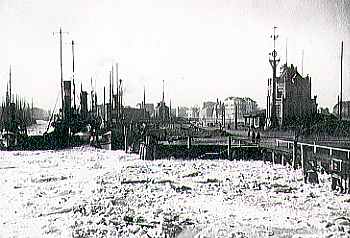
The first picture on this page on 18 August 1875 of the Cuxhavener photographers J. O. Angelbeck from the protection wall of the "Alte Liebe" were accepted (approximately at height of the semaphore). In the background the former pilot guardhouse on the ton yard is to be detected. On the right beside the time ball 1879 the imperial post office Cuxhaven 2 with the new Telegraph offices (late naval signal place) developed.
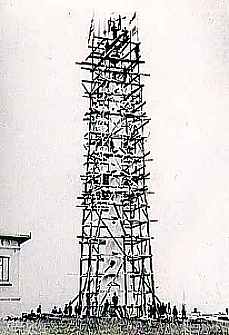
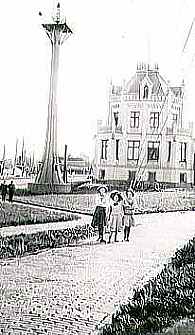
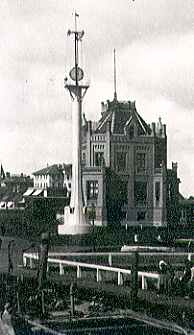
The Cuxhavener time ball became to 20. October 1875 of its regulation transfer. Its column was on a storm tide secure concrete foundation. On a 2.6 square meters large platform was into 16 meters height actual, further 8 meters the high, time apparatus with the time ball of 1.5 meters of diameters, whose head amounted to 3 meter. The clearing of the ball took place on electrical way via one in the Telegraph office (in former times ivy house in the post office road, starting from 1879 with the "Alte Liebe") set up clock, which was compared over its own telegraph line with the clock of the observatory in Hamburg village. Today, in the age of the broadcast and television, we are provided pervasively with time signs. At its time the time ball fulfilled the important function, that in the port as well as on the Reede are situated to transmit or Cuxhaven to occurring ships the exact time for the comparison of their stop watches. The accuracy of these signals was good, even if in the winter weather-caused disturbances were not to be excluded. The time ball gave never (also by its case not) an acoustic, but always an optical signal. First two signals were given. At 13 o'clock after Cuxhavener time and at 13.34 o'clock after Greenwicher time. One pulled the ball to ten minutes before each signal on half, 3 minutes before the time on whole height. To the given time-of-day one caused its falling electrically. When disturbances a small red ball was pulled for the half height of the stand. Later one gave only a signal, at 12 o'clock at noon to Central European time.
Starting from 1 April 1905 the imperial command in Cuxhaven supported the time signal acoustically, by her at 12 o'clock, with falling of the time ball, from which salut cannons of the Forts Grimmershoern fired a midday shot as signal for the military factories and barracks. This was today still the " Kluetenschuss " (Klueten = Mehlkloesse) ((a kind of german food)), legendary in Cuxhaven.
|